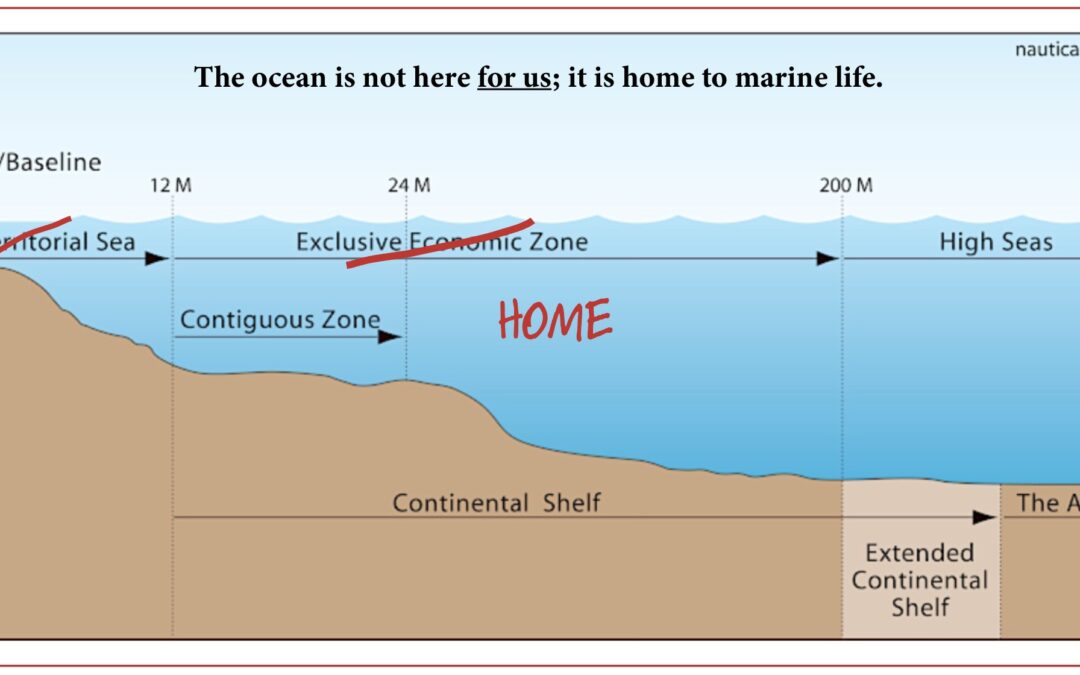
Modified image from the report. The ocean is not an economic zone for human use; the ocean is home to marine life.
A recent National Academies report examining offshore wind development along the U.S. West Coast raises serious concerns about the environmental risks of turning the Pacific Ocean into an industrial energy zone. Yet despite documenting numerous ecological uncertainties and potential harms, the report ultimately fails to confront the most important question: Should this development happen at all?
Our answer is emphatically “No!”
The report assumes that offshore wind expansion will proceed and focuses largely on how to manage the conflicts that follow. That framing reflects what we already know about federal and state energy policy: that it treats the ocean as the next frontier for industrial infrastructure rather than a living ecosystem deserving protection.
For those of us who believe the health of ecosystems must come first, this approach represents a profound failure of precaution and democratic decision-making.
The Pacific coast is not an empty landscape waiting for infrastructure. It is one of the most productive marine ecosystems on Earth. It is home to marine life including some of the largest animals left on Earth, whales, to some of the very smallest, the beings who form the basis of the marine food web that includes plankton, nudibranchs, by-the-wind sailors, and copepods.
The California Current ecosystem, stretching from British Columbia to Baja California, supports extraordinary biodiversity and a fishing economy worth billions of dollars. Nutrient-rich upwelling fuels plankton blooms that support forage fish, salmon, seabirds, whales, and coastal communities alike. The waters off Washington, Oregon, and California are also home to treaty-protected Tribal fisheries and some of the most important migratory corridors for marine life on the planet.
Introducing vast energy facilities into this system is a massive ecological intervention.
An industrial footprint at sea
The proposed offshore wind projects would consist of hundreds of enormous turbines, each much taller than Seattle’s Space Needle, mounted on floating platforms and connected by networks of cables and mooring lines. Turbines would be spaced roughly a mile apart across areas that could span hundreds of square miles.
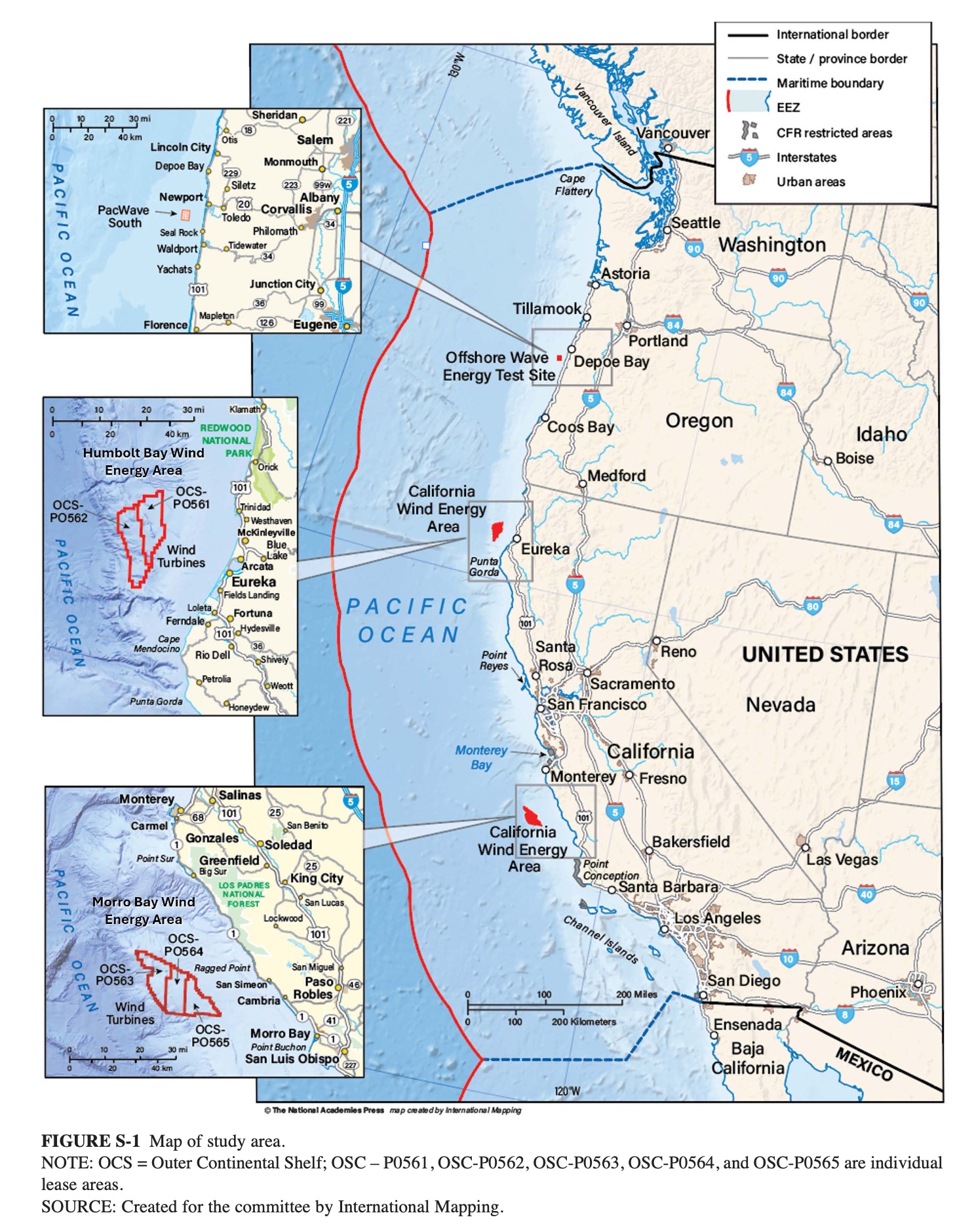
Proposed Wind Energy Areas
Before they even begin operating, wind projects disturb the seafloor through anchors and cables that damage benthic habitats. Floating platforms move in response to waves and currents, potentially dragging mooring lines across fragile seabed environments that scientists have barely begun to study.
Construction and maintenance activities introduce persistent underwater noise into ocean habitats that many marine species depend on for communication and navigation. Research from existing floating wind projects has detected turbine noise kilometers away and documented behavioral responses from marine animals.
The West Coast is critical habitat for gray whales, humpbacks, blue whales, orcas, and many other species already stressed by ship strikes, climate change, warming waters, declining food availability, and entanglement in fishing gear. Adding vast industrial infrastructure into these habitats risks compounding those pressures in ways we do not yet understand.
Unknown impacts on the ocean dynamics
One of the most concerning issues documented in the National Academies report involves the possibility that large offshore wind facilities could alter the physical dynamics of the ocean.
Wind turbines extract energy from the atmosphere. In doing so, they create wake effects that can change wind patterns locally. Along the Pacific coast, wind plays a crucial role in driving the coastal upwelling that fuels the entire marine food web. Upwelling brings nutrient-rich deep water to the surface, allowing plankton to flourish. Those plankton feed small fish, who in turn support larger fish, seabirds, marine mammals, and coastal fisheries.
Even modest disruptions to this system would cascade through the ecosystem.
Scientists still have very limited understanding of how large offshore wind arrays might affect these ocean processes. Many existing studies examine wind developments far smaller than the tens of gigawatts now proposed for the West Coast.
In other words, the region may be embarking on a massive ecological experiment with one of the most productive marine ecosystems on the planet.
What this means for the Pacific Northwest
For the Pacific Northwest, the stakes are particularly high.
The waters off Washington and Oregon sustain some of the most culturally and economically important fisheries in North America. Salmon, halibut, groundfish, and especially Dungeness crab support coastal communities and Tribal nations throughout the region.
These fisheries are already under strain from climate change, warming ocean temperatures, harmful algal blooms, over-fishing, and declining herring and salmon populations. Disrupting the ocean processes that sustain these natural communities could further destabilize fisheries that have supported the region for generations.
The Pacific Northwest is also one of the most important whale migration corridors in the world. Gray whales travel through these waters every year on their migrations between Mexico and Alaska. Humpback whales have returned in growing numbers to feed in productive coastal waters, while blue whales and orcas pass through the region as well, including critically endangered Southern Resident orcas.
Seabird populations, including species who nest on islands, cliffs, and the few remaining patches of old-growth forests along the Washington and Oregon coasts, depend on the same productive marine environment. Yet the areas being considered for offshore wind development overlap with many of these ecological hotspots.
Why are policymakers targeting one of the richest marine ecosystems on Earth for large-scale industrial development? Money, of course.
Risks to wildlife
Offshore wind infrastructure introduces a range of additional ecological risks.
Subsea power cables generate electromagnetic fields that may interfere with fish and crustaceans that rely on Earth’s magnetic field to navigate. Bird and bat collisions with turbine blades remain poorly studied for many offshore species; even a few collisions is a few too many. The structures themselves may act as artificial reefs, concentrating fish around turbines and altering predator–prey relationships. Floating wind platforms rely on long mooring lines extending into the water column, potentially creating new entanglement hazards for marine mammals.
These risks represent a significant transformation of ocean ecosystems that scientists still do not fully understand.
Tribal rights and coastal communities
Tribal nations throughout the Pacific Northwest possess treaty-protected rights to fish in their traditional waters, rights that were secured through solemn agreements with the United States government. Those rights include not only access to fish but the protection of the ecosystems that sustain them.
The offshore wind planning for the Pacific Northwest Coast that has been done so far has moved forward with little clarity about how these treaty rights will be protected if industrial infrastructure spreads across traditional fishing areas.
A policy process designed to approve development
Federal offshore wind policy is being led primarily by the Bureau of Ocean Energy Management (BOEM), an agency historically responsible for leasing offshore areas for oil and gas development. The same leasing model used to auction drilling rights is now being used to allocate ocean space for wind energy developers.
This approach treats the ocean as a commodity: a space to be parceled out for industrial use. Lease areas are identified first; developers bid for access, and only then does the full environmental review process unfold.
In other words, the fundamental decision about whether these areas should host industrial infrastructure has largely already been made before the public even begins to evaluate the impacts.
The National Academies report reflects this same underlying assumption. Rather than questioning whether offshore wind development is appropriate in ecologically sensitive waters, the report focuses on how agencies might reduce conflicts once development is underway. This is simply industrial planning with little thought for the marine life who will be impacted.
The illusion of mitigation
Proponents typically argue that environmental risks can be addressed through monitoring and adaptive management.
But monitoring damage after it occurs is not the same as preventing it. Once turbines, anchors, cables, and transmission corridors are installed across large areas of ocean, the ecological changes they introduce cannot be reversed. If whale and bird migration routes are disrupted, if the basis of the marine food web is interrupted, the damage would unfold over decades if not centuries.
The National Academies report acknowledges significant scientific uncertainty about these impacts. Yet instead of recommending a pause until the science is clearer, or recommend against development, the report effectively recommends more research while development proceeds.
That is experimentation at ecosystem scale.
The ocean deserves better
Climate change is real, and we absolutely must reduce our fossil fuels use. As we’ve documented elsewhere, adding more energy availability with wind energy areas does not reduce global use of fossil fuels; rather, it expands the available energy to the global industrial system.
And climate change is not our only problem. It is one of many symptoms of ecological overshoot, symptoms that also include catastrophic biodiversity loss and wildlife loss. Industrializing one of the most important marine ecosystems on Earth will simply accelerate that decline.
The Pacific Ocean is not an empty frontier for energy development. It is a living community; an ocean world that sustains wildlife, cultures, and communities along the entire West Coast and especially here in the Pacific Northwest.
The precautionary principle tells us that when an action carries the risk of serious or irreversible environmental harm, the burden of proof should fall on those proposing the action. In the case of offshore wind development along the Pacific coast, that burden has not been met, nor could it ever be.
As ocean industrialization accelerates around the world, we here in the Pacific Northwest have an even greater responsibility to defend the coast from energy development and the irreversible damage that development will cause, and to protect the extraordinary web of marine life who call the coast home.
Summary of the report
Read the full report here: https://www.protectthecoastpnw.org/wp-content/uploads/2026/03/NationalAcademiesOffshoreWind_2026.pdf
The National Academies report, Offshore Renewable Energy Development on the West Coast: Understanding Effects on Shipping, Fisheries, and Maritime Activities, examines what could happen if offshore renewable energy projects, especially floating offshore wind farms, are built off the coasts of California, Oregon, and Washington.
The goal is to understand how these projects might affect:
- Commercial shipping
- Commercial, recreational, and Tribal fishing
- U.S. Coast Guard operations
- Marine ecosystems
- Coastal communities
Congress asked the National Academies to study these issues because offshore wind development is expanding but the West Coast ocean is already heavily used.
Why offshore wind is being considered
West Coast states have laws incentivizing so-called “renewable” energy to meet stringent climate goals. As a result these states are looking at:
- California: up to 25 gigawatts of offshore wind by 2045
- Oregon: exploring up to 3 GW
- Washington: studying offshore wind as part of carbon-free electricity plans
The West Coast has strong winds, making offshore wind attractive.
However, the continental shelf is narrow and water gets deep quickly, so projects would use floating wind turbines rather than turbines fixed to the seabed.
What offshore wind projects would look like
Typical West Coast projects would include:
- Very large turbines (15+ MW each)
- Rotors up to ~250 meters (820 feet) wide (about 2.2 football fields long)
- Turbines floating on platforms
- Anchors and cables attached to the seabed
- Electrical cables connecting turbines to shore
Projects might include hundreds of turbines spaced about a mile apart.
Why development is complicated on the West Coast
The ocean off the West Coast is already subject to many important human uses:
- Major shipping routes
- Ports like Los Angeles, Long Beach, Seattle, and Tacoma handle over one-third of U.S. imports.
- Valuable fisheries
The California Current ecosystem is one of the most productive marine ecosystems in the world. Important fisheries include:
- Dungeness crab (≈30% of fishery value)
- Pacific whiting
- Market squid
- Salmon
Fishing provides hundreds of thousands of jobs and billions in economic activity.
Tribal fishing rights
Many Tribes have treaty-protected fishing rights, including the right to fish in traditional areas and to protect the habitats those fisheries depend on.
Environmental impacts
The report says impacts are still uncertain and need more research. Possible effects include:
- Seafloor disturbance
- Anchors and cables could affect bottom habitats.
- Noise and electromagnetic fields
- May influence fish or crab behavior.
- Changes to ocean circulation
- Large wind farms might slightly alter wind patterns or nutrient upwelling locally.
- Marine mammals
- Risk of entanglement in mooring cables is considered low but uncertain.
The report claims, without evidence, that many impacts are expected to be local rather than regional.
Specific environmental impacts discussed in the report
The report identifies several categories of environmental effects, many of which remain uncertain because floating offshore wind (FOW) has not been deployed at large scale in deep Pacific waters yet.
1. Changes to ocean circulation and productivity
One of the most interesting concerns is alteration of wind-driven ocean processes. Offshore wind turbines extract energy from the wind and create wake effects behind them. This can alter:
- Coastal upwelling
- Nutrient supply
- Primary productivity (plankton growth)
These processes are crucial to the California Current ecosystem, which supports major fisheries.
Current modeling only considers about 8 GW of wind capacity, while California plans up to 25 GW, so impacts at that scale are unknown. This is important because upwelling ultimately drives:
- plankton production
- fish populations
- seabirds and marine mammals
So even small physical changes could ripple through the food web.
2. Seafloor disturbance
Floating wind still requires seabed infrastructure:
- anchors
- mooring lines
- cables
These disturb bottom habitats and may even sweep across the seabed as platforms move in waves. Impacts could include:
- damage to benthic habitats
- changes in sediment
- impacts to species living on the seafloor
3. Noise pollution
Offshore wind produces noise during several phases:
- site surveys
- construction
- operation
- maintenance
Operational turbine noise has been measured up to about 4 km away from floating wind arrays in Scotland. Observed effects include:
- harbor porpoises avoiding turbine areas
- possible behavioral changes in marine animals
Construction noise can also disturb animals, though floating turbines require less pile driving than fixed-bottom turbines, so impacts may be somewhat lower.
4. Electromagnetic fields from cables
Transmission cables create electromagnetic fields (EMFs). Some marine species appear sensitive to these fields:
- larval fish show altered swimming behavior
- shore crabs may congregate near cables
These effects are expected to be localized, but their ecological consequences are still unclear.
5. Marine mammals
Several potential risks exist:
- habitat disruption
- behavioral changes
- entanglement with cables
- possible collision with structures
Primary entanglement risk is thought to be low, because cables are large enough to detect and avoid. But secondary entanglement (e.g., animals caught in fishing gear snagged on cables) is still uncertain.
The report also notes that effects on whale migration routes are unknown.
6. Birds and bats
Bird impacts are less studied on the West Coast but are important. Potential issues include:
- collision with turbine blades
- displacement from feeding areas
- impacts on migratory species
Some seabirds fly below turbine blade height, but species such as sooty shearwaters may fly higher and could be at greater risk.
7. Fish and ecosystem changes
Wind structures can act as artificial reefs or fish aggregation devices, attracting some species. Possible effects include:
- shifting fish distribution
- changes in predator-prey relationships
- altered fishing patterns
This could benefit some species but harm others.
8. Disruption of fisheries science
Wind farms could prevent traditional scientific fish surveys from being conducted in those areas, especially those using trawl gear. That could make it harder to monitor fish stocks accurately, which could affect fishery management. The report repeatedly emphasizes that we simply don’t know many of the effects yet.
For example:
- No large floating wind farms exist in deep Pacific waters
- Effects on fish migrations, whales, and ecosystems remain poorly studied
- Baseline data about species distributions is incomplete
Offshore wind here would be an ecological experiment.
6. Effects on fishing
Fishing may be the most directly affected industry. Potential issues:
- Some fishing gear (like trawls or longlines) may not be usable inside wind farms.
- Fishers could lose access to traditional fishing grounds.
- Offshore wind structures could attract fish (like artificial reefs).
The effects will vary depending on the fishery and turbine design.
7. Effects on shipping and safety
Wind farms could affect navigation and safety. Possible issues:
- Ships may need to go around wind farms.
- Radar signals can be disturbed by turbines.
- Search-and-rescue operations could become more complicated.
To reduce risk, the Coast Guard recommends:
- Regular turbine spacing (~1 nautical mile)
- Clearly marked navigation corridors
- Better radar processing and lighting standards.
8. Major concerns from communities and Tribes
The report says the current planning process has often been controversial. Common complaints include:
- Tribal governments not adequately consulted
- Fishing communities not involved early enough
- Lack of good data about fishing locations
- Uncertainty about environmental impacts
The report emphasizes the need for better consultation and collaboration.
9. Infrastructure challenges
The West Coast currently lacks the infrastructure needed to build large offshore wind farms. For example:
- Only a few ports could handle turbine assembly.
- California estimates about $11.7 billion in port upgrades may be needed.
10. Key recommendations from the report
The committee recommends:
- More research
- Study impacts on ocean ecosystems and fisheries.
- Better Tribal engagement
- Provide funding so Tribes can participate meaningfully in planning.
- Better spatial planning
- Map fishing grounds, shipping lanes, and ecological areas before siting projects.
- Safety measures
- Establish navigation corridors and update Coast Guard procedures.
- Environmental monitoring
- Require long-term monitoring of wind farms with public data.
- Improved planning
- Coordinate federal agencies, states, Tribes, and ocean users earlier in the process.
The report implicitly encourages development
The tone of the report is not “should we build offshore wind?” but rather “How should we plan and manage it if it happens?”. Its recommendations focus on:
- more research
- better spatial planning
- improved consultation with Tribes and fisheries
- monitoring impacts
- adaptive management
For example, one recommendation asks NOAA to identify research needs and fill data gaps about ecosystem impacts before planning continues. This framing assumes that development is likely or desirable, and the goal is to reduce conflicts and risks.
This is typical for National Academies reports commissioned by policymakers. Their mandate is usually not to decide policy goals but to help implement policy more effectively.
Since West Coast states already have offshore wind targets, the committee focused on how to mitigate impacts and how to plan projects more intelligently, rather than arguing for or against the technology itself.
The report contains two competing ideas:
1. The ecosystem is complex and poorly understood:
- many impacts uncertain
- some could affect fisheries or species
2. Climate and energy policy strongly favors offshore wind. So the report’s solution is essentially:
“Proceed, but do much better science and planning.”
This is a version of the classic approach to mitigate and monitor rather than pause or terminate projects.